
A few extra days for a careful, specialist survey can prevent weeks of confusion, unnecessary work and avoidable delay later.
Buying a home creates pressure to move quickly
Once an offer is accepted, everyone seems to want the next step completed immediately. The estate agent wants momentum, the seller wants reassurance and the buyer is understandably keen to avoid losing the property. In that atmosphere, it can be tempting to choose whichever surveyor can attend first.
Sometimes the first available appointment is also the right appointment. Sometimes it is not. For a listed, period or traditionally constructed building, the more important question is whether the surveyor has the right experience, the right scope and enough time to understand the property properly.
Waiting a little longer for the right surveyor may feel uncomfortable at the start of a purchase. Yet a rushed or poorly interpreted report can create much greater delay later, especially when it recommends unnecessary treatments, sends the buyer to several different contractors or raises serious-sounding concerns without explaining their cause or significance.
Does a full diary mean a surveyor is trusted?
It can be a reassuring sign, but it should never be the only reason you appoint someone. Good specialists are often in demand because previous clients recommend them, local professionals know their work and the practice deliberately limits how much it undertakes.
A well-managed diary may also show that the surveyor is protecting the time needed for each property. This is especially relevant for old buildings, where the inspection is only one part of the service. Preparation, research, analysis, photography, report writing and follow-up all require professional judgement.
At Smith Heritage Surveyors, our listed-building service is intentionally limited to one survey per day and a maximum of three per week. That is not about creating a waiting list for the sake of it. It is about giving each property the time, care and detail it deserves, while still providing the completed report within the stated turnaround.
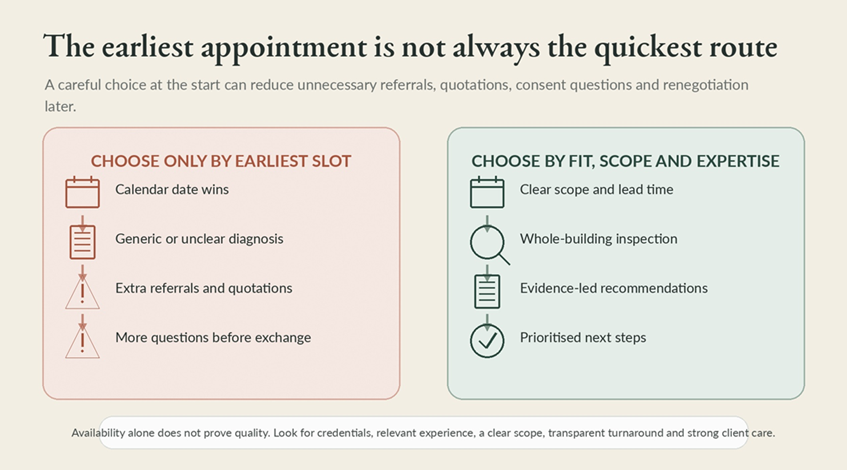
Choosing carefully at the start can be the faster route through the purchase as a whole.
What a thorough survey actually involves
A proper building survey does not begin when the surveyor arrives at the front door, and it does not end when they leave. A good service usually has several connected stages.
- Preparation: reviewing the property type, age, listing information, sales particulars, known alterations and the client’s particular concerns.
- Inspection: allowing enough time to assess the building as a whole, including roofs, chimneys, rainwater goods, walls, windows, floors, lofts and visible services, subject to access and safety.
- Diagnosis: considering patterns of moisture, movement, decay and alteration in context rather than simply recording isolated symptoms.
- Reporting: explaining the evidence, likely causes, risks, repair options, priorities and any need for further investigation or consent.
- Aftercare: answering questions, discussing urgent findings and helping the client understand what should happen next.
The older or more unusual the property, the more important these stages become. Traditional buildings often use solid walls, lime mortars, timber frames, thatch, soft brick, stone and other materials that behave differently from modern construction. A generic diagnosis can therefore be misleading even when the initial observation is genuine.
How a weak survey can create delay instead of preventing it
The purpose of a survey is not to make a property sound frightening. It is to give the buyer a clear, proportionate understanding of condition and risk. Problems arise when a report records symptoms without doing enough to interpret them.
Example 1: a red moisture-meter reading becomes “rising damp”
A meter gives a high reading at the base of a wall. The report immediately recommends a damp-proofing contractor. The contractor then proposes chemical injection, removal of plaster and a waterproof system. The buyer seeks quotations, the solicitor raises questions and the lender may ask for evidence that the work will be completed.
Yet the original cause might be a leaking gutter, high external ground levels, condensation, salts in old plaster or an impermeable modern coating. In that situation, the chain of referrals and quotations has not clarified the problem. It has added expense, alarm and delay.
SPAB specifically advises caution where a retrofit damp-proof course is proposed merely from electrical moisture-meter readings. Historic England and the joint industry guidance also emphasise a holistic diagnosis that deals with causes rather than symptoms.
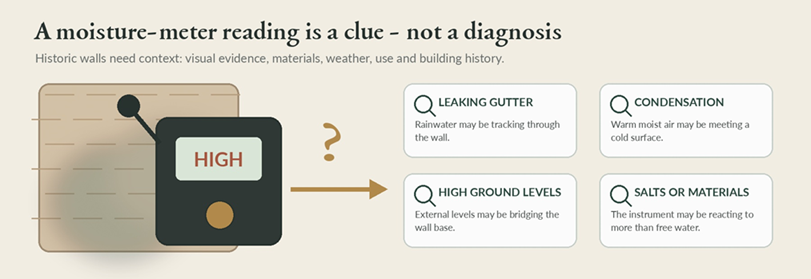
In historic buildings, instruments support professional judgement; they do not replace it.
Example 2: “replace everything” is treated as the safest advice
A report may recommend replacing all sash windows, roof timbers or areas of plaster because they are old, weathered or locally defective. That can sound decisive, but it may not be proportionate.
Traditional fabric is often repairable. Localised timber splicing, overhaul of joinery, compatible lime repair or improved rainwater detailing may retain far more of the building and cost less than wholesale replacement. On a listed building, unnecessary replacement may also introduce consent questions and the risk of losing historic character.
A good surveyor should not recommend repair simply because it sounds conservation-friendly, nor replacement simply because it is easier to specify. The recommendation should follow the evidence, the significance of the fabric and the consequences of each option.
Example 3: every uncertainty becomes another specialist report
There are times when an engineer, electrician, drainage contractor, roofer or laboratory test is genuinely needed. Referring to another specialist is not poor practice in itself.
The problem is an unfiltered list of referrals with no explanation of what each person is being asked to investigate, how urgent it is or whether the result is likely to affect the purchase. The buyer can then spend valuable time commissioning several inspections that overlap or do not answer the original question.
A stronger report narrows the issue. It explains the evidence, identifies the specific uncertainty and tells the client what further investigation is intended to establish. That makes the follow-up faster and more useful.
Example 4: serious language without useful context
Words such as movement, decay, damp and infestation naturally cause concern. A poor report may use them without distinguishing between historic and active movement, superficial damage and structural loss, or old insect flight holes and current activity.
A careful report explains what was seen, why it matters, what is likely to have caused it and how quickly action is needed. That context helps the buyer make a decision rather than simply passing the worry to the next person.
| A useful rule The best survey is not the one that recommends the most work. It is the one that explains the building, identifies the real causes and helps you act in the right order. |
What respected guidance says
The principles behind good surveying are well established.
- RICS sets a framework for consistent, high-quality residential survey services and expects the inspection and report to match the agreed level of service. For a Level 3 service, the depth of investigation and explanation should reflect the complexity of the property.
- Historic England and the joint position statement on moisture in traditional buildings call for a whole-building, evidence-led approach. The guidance says diagnosis should identify and deal with causes rather than focus only on symptoms, and recognises that damp investigation may need to be staged.
- SPAB promotes conservative repair: obtain sound information before serious intervention, use compatible materials and retain historic fabric where possible. It also warns that an inappropriate remedy can be more damaging than the defect.
These principles are particularly important during a purchase. The buyer needs enough information to make a decision, but the recommendations should still be proportionate. Overstating a problem can be almost as unhelpful as missing it.

Good surveying turns observations into clear, proportionate advice.
What a good report should tell you
For each important issue, a useful report should answer six straightforward questions:
| 1. What was found? A plain-English description supported by photographs. | 2. What is the likely cause? The building-pathology explanation, not just the symptom. |
| 3. Why does it matter? The risk to fabric, occupants, value or the purchase. | 4. What should be done? A proportionate repair, management or monitoring option. |
| 5. When should it be done? Urgent, before exchange, soon after purchase or routine maintenance. | 6. Is anything else needed? A focused specialist check, quotation, consent enquiry or opening-up investigation. |
Why Smith Heritage protects time in the diary
Our approach is designed around careful inspection and clear advice rather than volume. For listed-building surveys, we undertake only one survey per day and no more than three in a week. This allows time for the property, the analysis and the client conversation.
Our listed-building service is carried out by Building Conservation Accredited professionals and is tailored to historic and period homes. Depending on the property and conditions, the inspection may include thermal imaging, atmospheric measurements, damp and timber assessment, a pole-camera or drone view of high-level areas, review of alterations and practical repair guidance.
Technology is useful, but it remains supporting evidence. A thermal image, moisture reading or drone photograph has to be interpreted in the context of materials, construction, weather, use and maintenance history.
We also believe the report should begin a conversation, not end it. Clients can speak with the surveyor on the day, arrange a follow-up call and ask further questions after receiving the report. Our published turnaround for listed-building reports is within three working days, so a short wait for the inspection does not mean an open-ended wait for the advice.
| Why this can save time overall A clear diagnosis can reduce unnecessary contractor visits, prevent unsuitable work from being priced, focus negotiations on genuine defects and help solicitors or lenders receive more precise answers. |
What to do when the agent is pushing for speed
You do not need to ignore the pace of the transaction. The aim is to manage it intelligently.
- Ask for two dates: the inspection date and the expected report date. A slightly later inspection with a firm report turnaround may still be quicker overall.
- Tell the agent and solicitor that a specialist survey is booked. A clear plan is more reassuring than vague promises to arrange something.
- Send documents early, including sales particulars, the listing entry, known alterations and any concerns raised during viewings.
- Ask whether urgent findings can be discussed on the day or shortly afterwards, before the full report is issued.
- Compare scope and expertise, not just fee and availability. Ask who will inspect, how long is allowed, what high-level inspection is included and whether you can speak directly with the surveyor.
The right surveyor can also tell you when not to act
One of the most valuable conclusions in a survey can be that a dramatic intervention is not justified. A defect may need monitoring, routine maintenance or a small local repair rather than stripping out historic fabric or installing a system that the building does not need.
That kind of judgement takes confidence and experience. It is easier to recommend more work and pass responsibility to a contractor. It is harder – and more useful – to explain why a limited, staged or conservative response is appropriate.
So, when a respected specialist says their diary is full for a short period, do not assume the wait is a problem. Ask the right questions, check the scope and credentials, and consider the whole purchase timeline. A few extra days at the beginning may give you a far clearer decision and a much smoother route forward.
Thinking about a survey for a period or listed property?
Smith Heritage Surveyors provides detailed, conservation-led surveys for historic, listed and traditionally constructed buildings across the South of England, Wales and further afield.
To discuss the property, the most suitable survey and our current inspection dates, contact the team on 01722 683 849 or email info@smithheritagesurveyors.com.
| BOOK THE RIGHT SURVEY – NOT SIMPLY THE FIRST SLOT Visit smithheritagesurveyors.com to request a quote or book online |