

A day spent checking the roof, gutters, walls and ventilation can prevent a winter of avoidable damp and decay.
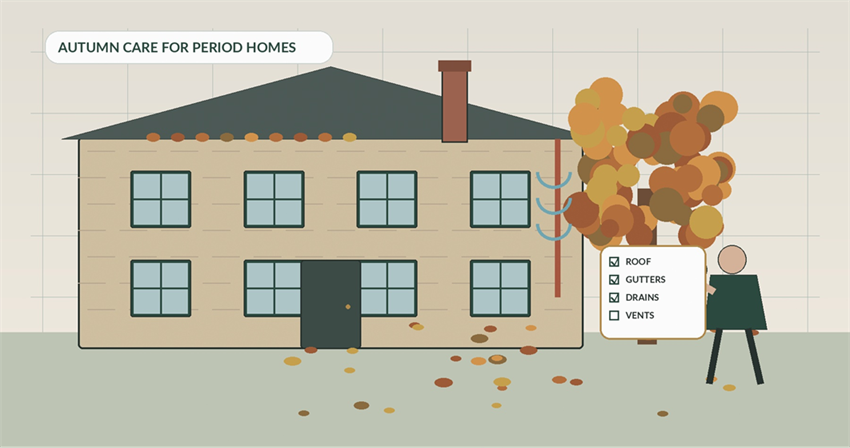
Autumn is the ideal time to check how water moves from the roof, through the rainwater system and safely away from the building.
The main point Regular maintenance is the most effective and least disruptive form of building conservation. Before winter, check the route of rainwater from the roof to the ground, keep ventilation paths open, record small defects and arrange compatible repairs before water and frost turn them into larger problems.
Why autumn is the most useful maintenance season
Leaf fall, stronger winds, prolonged rain and the first cold nights expose weaknesses that may have gone unnoticed through summer. A partly blocked gutter starts to overflow. A loose slate shifts in a gale. A cracked downpipe wets the wall behind it. An obstructed air brick leaves a suspended floor with less ventilation just as the building becomes colder and damper.
None of these defects is dramatic at first. That is precisely why regular inspection matters. Historic England describes good maintenance as the primary measure for protecting condition and improving performance, while SPAB has long promoted routine care as the best way to prevent decay.
The aim is not to make an old house perfect. It is to keep water moving safely away, help the building dry, retain sound fabric and address small faults before they require invasive work.

Inspecting in a logical order helps connect an internal symptom with its likely external source.
1. Start with chimneys, roofs and high-level details
Inspect from the ground with binoculars or a suitable pole camera. Do not climb roofs or work at height unless you have the training, equipment and safe access to do so.
- Look for missing, slipped, cracked or lifted slates and tiles, particularly after high winds.
- Check ridge tiles, hips, verges and mortar fillets for displacement or open joints.
- Look for lead flashings that have lifted, split or pulled away from chimneys and abutments.
- Check chimney pots, flaunching and masonry for cracks, vegetation, leaning or loose components.
- Where the building has valleys, parapets or concealed gutters, make sure outlets are clear and water is not ponding.
Debris on the ground can be the first sign of a roof problem. After heavy rain, inspect the loft where it is safe and accessible, paying particular attention below valleys, chimneys, gutters and roof junctions.
2. Watch the gutters and downpipes while it rains
A dry-day inspection may show leaves, corrosion and loose brackets. A wet-day inspection shows whether the system actually works. Stand safely at ground level and watch how rainwater moves.
- Does water overshoot or cascade over the gutter?
- Are joints dripping or the rear of a cast-iron pipe split?
- Does water sit in one part of the gutter instead of flowing to the outlet?
- Are hopper heads blocked by leaves, moss or nesting material?
- Does the downpipe discharge into a clear gully and carry water away from the wall?
Historic England’s rainwater guidance stresses regular inspection, routine maintenance and review after extreme weather. Staining, algae, washed-out mortar and damp patches behind a pipe are all clues that the system is not containing water properly.
3. Clear gullies and understand where the water goes
A clear downpipe is only useful if the gully, drain or soakaway can accept the flow. Remove leaves, silt and debris from accessible gratings. During rain, check that water disappears freely rather than pooling against the base of the wall.
Repeated backing-up may indicate a blocked or damaged drain, a failed soakaway or a system that cannot cope with current rainfall. Avoid simply redirecting water onto another part of the building or neighbouring land without understanding the drainage route.
4. Read the external walls
Walk around the building slowly. Compare sheltered and exposed elevations. Look below gutters, around window heads, at chimney abutments and wherever materials change.
| Open mortar joints Deep erosion or missing pointing can admit more water and leave masonry edges vulnerable. | Cracked or hollow render Record the extent and investigate the cause before patching with a harder material. |
| Green staining and algae Growth often follows persistent wetting from overflow, splashback or defective detailing. | Spalling brick or stone Flaking faces may be worsened by trapped moisture, frost or incompatible hard repairs. |
| Unfamiliar new cracks Photograph, date and seek advice where movement appears recent or progressive. | Vegetation Remove damaging growth carefully and keep dense planting from blocking inspection and airflow. |
Do not reach for waterproof coatings as a general solution. A wall that is wet because the gutter above is overflowing needs the rainwater defect resolved. Surface sealing can hide the symptom while moisture continues to enter elsewhere.
5. Check ground levels, air bricks and the base of walls
Soil, mulch, gravel and new paving often rise gradually around an old house. High external levels increase splashback, can bridge original moisture details and may block subfloor ventilation.
- Keep air bricks and subfloor vents clear of soil, leaves, stored items and dense planting.
- Check that paving falls away from the wall and does not direct runoff towards doors or low masonry.
- Historic England uses 150 mm below a known damp-proof course or internal floor level as a useful general check, although the correct detail depends on the building.
- Look for leaking outside taps, overflows and water butts that saturate the wall or foundation area.
6. Inspect windows, doors and exposed timber
Pay particular attention to sills, thresholds, lower rails, end grain and the underside of sashes. Bare timber, cracked putty and open joints should be repaired before prolonged wet weather allows decay to extend.
Make sure windows can be opened safely for controlled ventilation. Lubricate suitable ironmongery, check cords and catches, and avoid painting moving parts shut. Small local decoration is often more sensible than waiting until complete stripping and major repair are required.
7. Look inside after heavy rain
Some defects are easiest to identify when the building is under load. After a period of rain, inspect accessible roof spaces, upper corners, chimney breasts, window heads, cupboards on external walls and the underside of valleys and gutters.
Record staining, drips, musty odours and changes in timber. Do not assume a mark at low level began at ground level; water can travel along joists, pipes, wall cores and finishes before it appears.
8. Prepare services and manage indoor moisture
- Have boilers and heating systems serviced by appropriately qualified people and check for leaks.
- Protect vulnerable tanks and pipes from frost and know where the stopcock is located.
- Test smoke and carbon-monoxide alarms and arrange competent inspection of gas and electrical systems as required.
- Use kitchen and bathroom extraction, keep background ventilation working and avoid sudden extremes of heating where possible.
Older buildings do not need uncontrolled draughts, but they do need a sensible balance of heat, air movement and moisture removal. Condensation is more likely when indoor humidity rises and surface temperatures fall.
Poor maintenance habits that create bigger repairs
Waiting for the internal stain
By the time a ceiling mark appears, roof timbers, insulation or wall fabric may already have been wet for some time. External inspection is cheaper than tracing hidden water later.
Patching the symptom with hard materials
A quick cement patch or waterproof coating may be harder and less permeable than the surrounding fabric. If the water source remains, deterioration may move to the adjacent brick, stone or timber.
Clearing the gutter once but ignoring the cause of repeated blockage
Overhanging trees, poor falls, undersized outlets, pigeon activity or difficult access may require a revised maintenance frequency or a carefully designed improvement.
Doing unsafe high-level work
Ladders, roofs and fragile coverings present serious hazards. Use ground-based observation and appoint competent contractors where safe access is not available.
Create a simple maintenance record
A maintenance log turns isolated observations into useful evidence. Record the date, weather, location, photograph, action taken and contractor details. Repeat photographs from the same viewpoint make change easier to see and help a surveyor or contractor understand recurring problems.
| A practical priority system Do now: active leaks, loose materials, blocked outlets and safety issues. Plan this season: compatible pointing, local joinery repair and drainage improvements. Monitor: stable cracks, weathering and items that are serviceable but nearing maintenance. |
Listed buildings and repairs
Straightforward like-for-like maintenance may not require Listed Building Consent, but alterations, replacement of significant fabric and changes in materials or appearance may do so. When in doubt, consult the local planning authority before work starts.
Choose contractors who understand traditional materials. The least expensive quotation can become costly if a hard or incompatible repair has to be removed later.
How Smith Heritage can help
Smith Heritage Surveyors provides Listed Building Surveys, RICS Level 3 Building Surveys, Damp and Timber Surveys and Defects Surveys across the South of England and Wales. Our reports explain not only what needs attention, but why it is happening and how to prioritise the response.
For owners, a condition or defect inspection can help turn a long list of concerns into an ordered maintenance plan. For buyers, the survey provides a baseline for future care before small issues become expensive surprises.
The conclusion: maintenance is conservation
The most successful old houses are not those that never develop defects. They are the ones where water is managed, ventilation is maintained and small changes are noticed early.
A careful autumn inspection protects the building, reduces winter surprises and gives you time to arrange the right repair rather than the fastest emergency response.
| WOULD A CONDITION OR DEFECT SURVEY HELP? Visit smithheritagesurveyors.com to discuss the right survey for your property |