
Most old buildings have moved. The skill lies in deciding whether that movement is historic, harmless or active.
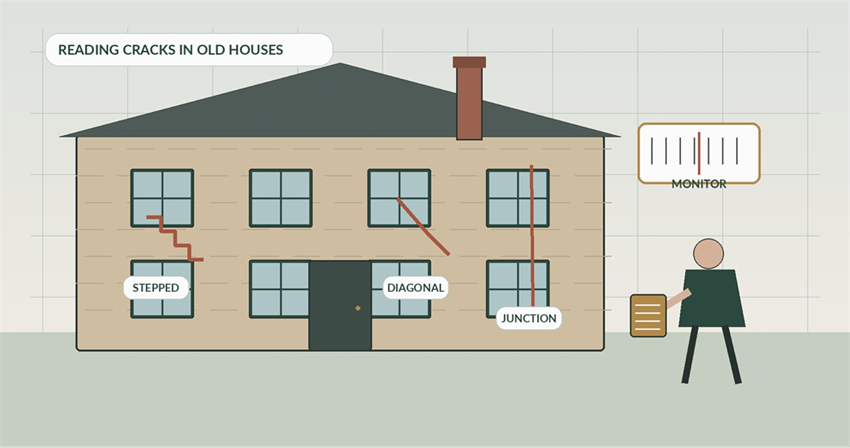
The shape of a crack is a clue. Its age, change, context and effect on the building determine its significance.
The main point Cracking in an old house does not automatically mean subsidence. Historic settlement, seasonal movement, shrinkage, alterations, failed lintels, roof spread, decay and drainage problems can all create cracks. A reliable assessment identifies whether movement is old or ongoing, considers the building as a whole and avoids major repair before the cause is understood.
Why cracks alarm buyers so quickly
A crack can turn an otherwise calm viewing into a conversation about subsidence, insurance and underpinning. Buyers may fear that the house is unstable; sellers may rush to fill and repaint the line; and a vague survey paragraph can trigger several referrals without explaining what the crack actually means.
Cracks deserve attention, but they also require proportion. Historic England notes that most old buildings move to some degree during their lives and that this movement may not be a problem. Traditional buildings are often more flexible than modern construction and can tolerate a degree of settlement and distortion without losing stability.
The surveyor’s task is therefore not simply to record the crack. It is to decide what caused it, whether the cause remains active, what risk it presents and what response is justified.
First, understand the terminology
| Settlement Downward adjustment as the building and supporting ground respond to load. Much settlement occurs early and may be entirely historic. | Subsidence Downward movement of the ground supporting the foundations, often linked to changing soil conditions, leaks, trees, mining or nearby works. |
| Heave Upward ground movement that can lift or distort foundations, sometimes following changes in moisture or removal of vegetation. | Structural movement A wider term covering movement within walls, floors, roofs, foundations and connections, whether historic, seasonal or continuing. |
These terms are related but not interchangeable. A sloping floor in a 300-year-old cottage may reflect long-completed settlement. A fresh stepped crack beside a leaking drain may indicate a current ground problem. A diagonal line above a window may relate to a lintel rather than the foundations.
Common reasons old buildings crack
Historic settlement and long-term adjustment
Older houses frequently have shallow foundations and may have been built in stages. Walls, floors and roofs settle, distort and share load over time. If the movement is historic and the structure has found a stable position, the resulting cracks may be part of the building’s story rather than evidence of present failure.
Thermal and seasonal movement
Materials expand, contract and dry at different rates. Junctions between old and new work, timber and masonry, or lime and dense modern plaster can crack as temperature and humidity change. These cracks may recur seasonally without indicating foundation subsidence.
Alterations and loss of support
Removing a wall or chimney breast, enlarging an opening, installing services through joists, adding a heavy roof covering or building an extension on different foundations can change the load path. Cracking may then appear some distance from the alteration.
Lintels, arches and openings
Openings concentrate stress. A decayed timber lintel, corroding metal support, flattened arch or inadequate replacement lintel can create diagonal or stepped cracks above doors and windows.
Roof spread and weak connections
A roof that is pushing outward, poorly restrained walls or inadequate links between walls and floors can produce horizontal cracking, bulging or outward movement. The whole structural arrangement must be considered.
Moisture, decay and defective drainage
Water can decay embedded timbers, erode mortar, corrode metal and soften or wash out supporting ground. Leaking drains, water mains and rainwater pipes are therefore relevant to both the fabric and the foundations.
Trees, clay soils and nearby excavation
Shrinkable clay can change volume as moisture conditions vary. Trees, prolonged dry weather, leaking services, basement excavation and adjacent construction may influence the ground, but causation should be assessed carefully rather than assumed from proximity alone.
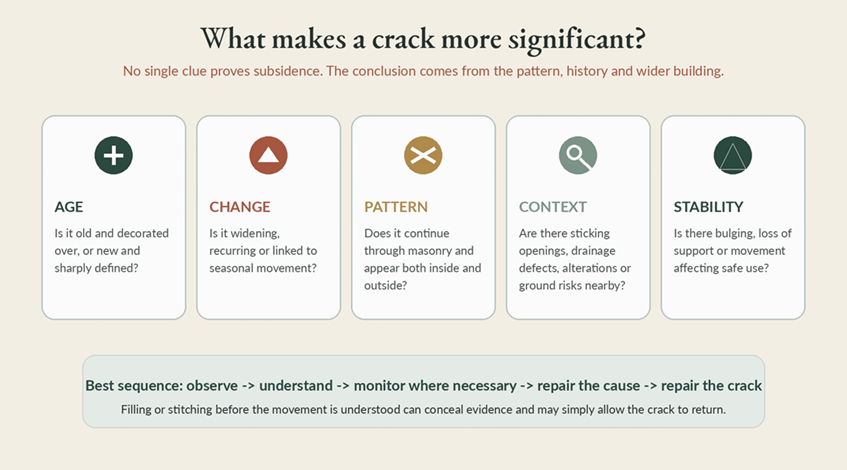
Cracks are interpreted as part of a building system, not as isolated lines on a wall.
What crack patterns can – and cannot – tell you
Crack shape helps direct the investigation, but no shape provides a complete diagnosis by itself.
- Stepped cracking through brick or block joints can relate to differential movement, but the location, direction and whether it is changing are crucial.
- Diagonal cracking above an opening may indicate local support or lintel problems, movement at an extension junction or wider foundation movement.
- Vertical cracks at the meeting point of old and new work commonly reflect different foundations, materials or drying behaviour.
- Horizontal cracking or bulging can be more significant where it suggests loss of restraint, corrosion, roof spread or instability.
- Fine internal plaster cracks may be superficial, particularly where hard modern finishes bridge flexible historic fabric.
The more useful questions are whether the crack is new, whether it is getting wider, whether it passes through the structural material, whether a corresponding crack appears on the other side and whether doors, windows, floors or roof lines show related change.
Poor practice that can make the problem worse
Calling every crack “subsidence”
This creates unnecessary alarm and can complicate insurance discussions. Subsidence is a specific ground-related mechanism, not a synonym for every form of cracking.
Filling and decorating before recording the evidence
Cosmetic filling can be reasonable once movement is understood, but doing it first may hide the crack’s extent and remove a useful baseline. If the cause is active, the crack will often return.
Recommending underpinning as an early answer
Underpinning is a major intervention and is not the routine cure for a crack. The cause may lie in a drain, lintel, roof, local alteration or historic settlement. Major foundation work should follow evidence, not fear.
Ignoring the building above and below the crack
A line on a bedroom wall may be connected to a roof thrust, chimney removal, floor structure, external drain or extension below. Local repair without a whole-building assessment can miss the real mechanism.
How a careful movement investigation works
| 1 | Read the history Review the age, phases of construction, extensions, structural alterations, previous repairs and any known insurance or monitoring records. |
| 2 | Map the evidence Record crack positions, directions and widths, and look for related distortion in floors, walls, openings, roof lines and external masonry. |
| 3 | Inspect likely causes Assess drainage, rainwater disposal, ground conditions, nearby vegetation, excavations, lintels, roof structure, wall restraint and concealed decay where accessible. |
| 4 | Decide whether monitoring is needed Where movement may be active but immediate danger is not indicated, dated photographs, gauges or measured monitoring can show whether change is continuing. |
| 5 | Bring in the right specialist at the right time A structural engineer familiar with old buildings may be required where stability, active movement or major intervention is in question. Drainage or arboricultural input may also be relevant. |
| 6 | Repair the cause before repairing the appearance Once the movement is stable or controlled, cracks can be repaired using compatible methods and materials with minimum loss of historic fabric. |
| When prompt professional advice is sensible Seek timely advice where cracking appears suddenly, is widening, is accompanied by bulging or loss of support, affects doors or windows significantly, follows nearby excavation or a major leak, or raises any concern about safe occupation. RICS notes that cracks appearing suddenly and wider than about 3 mm merit particular attention, but width alone is never the whole diagnosis. |
Repairing cracks in a historic building
The repair should follow the diagnosis. Fine stable cracks in lime plaster may need little more than compatible local repair and decoration. Open masonry joints may require selective repointing. Some structural cracks may justify carefully designed stitching, local rebuilding, improved restraint or repair to a lintel or roof.
Historic England’s repair principles favour a conservative approach: retain significant fabric, remedy the cause and use methods compatible with the existing material. A hard, highly rigid repair can move the stress into softer surrounding brick, stone or plaster.
How Smith Heritage can help
Smith Heritage Surveyors provides Defects Surveys, RICS Level 3 Building Surveys and specialist Listed Building Surveys for older and traditionally constructed properties. We assess cracking in context, explain the likely mechanism and distinguish urgent risk from historic character and routine maintenance.
Where a structural engineer or monitoring programme is appropriate, we explain why. Where the evidence supports a limited repair or no immediate intervention, we explain that too. The aim is a proportionate decision – not the most alarming label.
The conclusion: investigate movement before trying to erase it
A crack is evidence, not a verdict. Its significance depends on what is moving, why it moved, whether it is still moving and how the rest of the building is responding.
Good surveying turns that evidence into a clear plan: monitor where necessary, address the cause, involve the right specialist and repair with the least harmful effective method.
| CONCERNED ABOUT CRACKING OR MOVEMENT? Visit smithheritagesurveyors.com to discuss a Defects Survey |