
Traditional Windows: Repair, Upgrade or Replace?
Weathered paint is not a structural diagnosis, and replacement is not the only route to comfort.
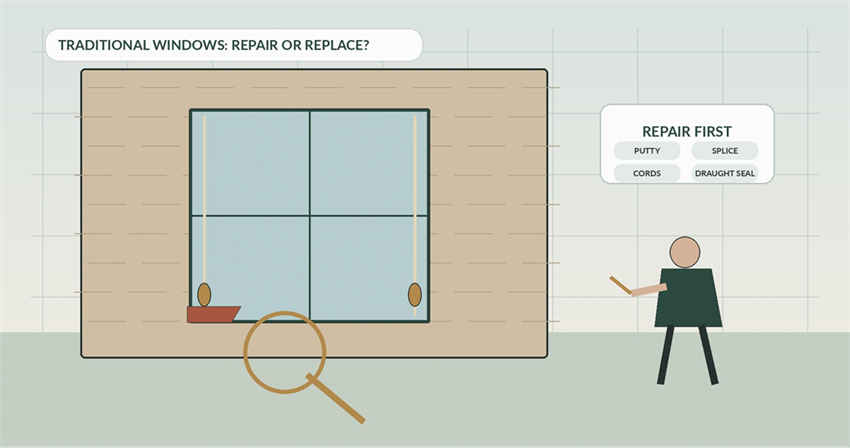
Traditional windows should be assessed component by component. Local wear does not automatically justify wholesale replacement.
| The main point Many historic timber windows that look tired can be repaired and upgraded. Peeling paint, failed putty, draughts or a small area of soft timber do not necessarily mean the whole window has failed. A sound decision identifies the moisture source, retains repairable fabric, improves comfort sensitively and treats replacement as a justified last option rather than the default. |
Why traditional windows matter
Windows do far more than keep out the weather. Their proportions, glazing pattern, mouldings, glass, ironmongery and relationship with the wall can be central to the character of a period or listed building. They also contain evidence of craftsmanship, alteration and use that a new unit cannot reproduce simply by copying the outline.
Historic England notes that traditional windows can contribute to the significance of listed buildings through their design, materials and workmanship. SPAB likewise begins from a strong presumption in favour of repair, particularly where limited decay can be addressed without sacrificing the rest of the window.
This does not mean every old window must be retained regardless of condition. It means replacement should follow a careful assessment rather than a sales quotation based on appearance alone.
Why a window can look worse than it is
Paintwork is the weathering layer. When it cracks or flakes, the window may look severely neglected even though much of the underlying timber remains sound. Putty can fail locally. Sash cords can break. Hinges and fasteners can seize. Joints can open, and the bottom rail or sill can decay where water has been allowed to sit.
These are defects, but they are often repairable defects. The key is to probe and inspect the timber, understand how far decay extends and identify why moisture is reaching or remaining in the vulnerable area.
| Surface wear Faded or flaking paint may require preparation and redecoration rather than structural replacement. | Failed putty Cracked or missing glazing putty can admit water but can usually be renewed carefully. |
| Local timber decay A sill, lower rail or joint may be spliced with compatible timber while retaining the sound majority. | Operational faults Cords, weights, pulleys, beads, hinges and catches can often be overhauled or replaced locally. |
| Frame-to-wall gaps Open joints around the frame may admit water and air; the junction should be repaired with compatible detailing. | Draughts and rattles These can often be reduced through adjustment and discreet draught-proofing without replacing the window. |
Repair first: what good window repair can involve
Deal with the moisture source
Wet rot needs persistent moisture. Before cutting timber away, check paint edges, putty, sill falls, drips, external pointing, blocked drainage channels, leaking gutters above and condensation on the internal face. A repair will not last if the cause remains.
Retain sound material
SPAB’s guidance recommends removing only the timber necessary to form an effective repair and working new material to the line of the old. Well-designed scarf or splice repairs can retain original rails, stiles and mouldings while renewing the vulnerable end or face.
Keep the window working as designed
Sash windows depend on balance. Casements depend on sound hinges and clear closing lines. Repairs should preserve movement, drainage and weathering details rather than simply making the frame look square or new.
Protect glass and details
Historic glass, fine glazing bars, ironmongery and surviving paint evidence may be significant. They should be recorded and protected, and original glass removed only where necessary and with great care.
Decorate properly
Paint protects timber, but complete stripping is rarely required. Remove loose and defective layers, repair the substrate, use a compatible paint system and maintain the seal between the paint and putty.
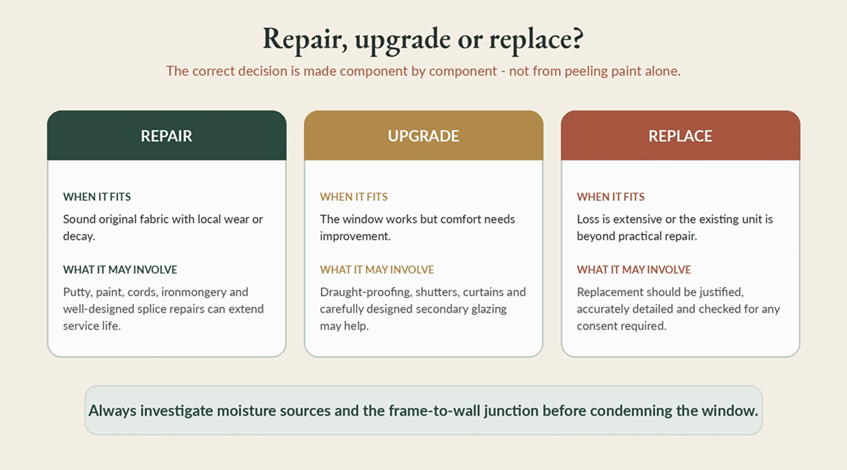
The best option depends on condition, significance, performance needs and the extent of sound original fabric.
Upgrading comfort without losing the window
Owners often consider replacement because rooms feel cold, draughty or noisy. Those problems are real, but replacement glazing is only one possible response.
- Draught-proofing can reduce uncontrolled air leakage and rattling while allowing the window to remain operable.
- Curtains and working shutters can improve comfort and are highly reversible.
- Secondary glazing can retain the external window while reducing air leakage, heat loss and noise when carefully designed.
- Local adjustment, re-edging, new beads and repaired frame-to-wall joints can improve both operation and weather resistance.
Historic England reports that carefully designed low-emissivity secondary glazing can substantially reduce heat loss through the window as a whole, while retaining historic fabric. The actual result depends on design, installation, ventilation and how the room is used.
Sealing every gap without considering ventilation can create a different problem. Traditional homes need controlled ventilation, particularly where cooking, bathing and drying clothes generate moisture. Energy improvement should therefore be approached as part of the whole building.
When replacement may be justified
Replacement becomes reasonable where the loss of material is extensive, structural joints cannot be recovered, distortion prevents safe operation, a fire or impact has caused major damage, or a modern inappropriate unit is being replaced with a more suitable design.
Even then, the assessment should distinguish the failed component from the whole window. A decayed sill does not automatically condemn both sashes and the box frame. One elevation may contain windows of different dates and significance. Replacement should be justified window by window and, where possible, valuable glass and ironmongery should be retained for reuse.
Poor practices to avoid
Condemning windows from the outside appearance
A quotation that recommends replacing every window after a brief visual check may not distinguish superficial decoration from deep decay. The condition of the timber and joints needs to be tested.
Replacing with standard plastic units
Standard replacement units can change frame proportions, glazing-bar depth, reflections, opening method and the relationship with historic masonry. In a listed building, alteration or replacement may require Listed Building Consent.
Using rigid or impermeable materials around the frame
Hard cement pointing and inappropriate sealants can crack away, trap moisture or direct water into the timber. The junction should shed water while remaining compatible with the wall and frame.
Removing old paint and glass too aggressively
Caustic dipping, heavy sanding and careless deglazing can distort timber, weaken joints, damage profiles and destroy old glass. Lead paint also requires appropriate safety controls.
Improving airtightness without a ventilation plan
A colder, draughty room may benefit from air-sealing, but indoor humidity and extract ventilation must be considered so moisture is not simply moved onto another cold surface.
Listed buildings and consent
Routine like-for-like maintenance may not require consent, but replacement, changes to glazing, altered sections, new opening methods and other works affecting special interest can require Listed Building Consent. The position depends on the building, the existing window and the proposal.
Before ordering units or removing historic fabric, discuss the proposal with the local planning authority’s conservation team and provide drawings, sections, photographs and a clear condition assessment where requested.
| A strong window assessment should separate four questions What is original or significant? What is actually defective? What can be repaired? What performance improvement is needed? Only then should replacement be considered. |
How Smith Heritage assesses traditional windows
During a Listed Building Survey or RICS Level 3 Building Survey, Smith Heritage considers the window together with the surrounding wall, lintel, sill, rainwater exposure, internal environment and previous repairs. We distinguish local maintenance from widespread failure and explain where specialist joinery advice or consent may be needed.
The aim is not to preserve defects. It is to avoid losing sound historic fabric unnecessarily while giving owners practical options for durability, comfort and maintenance.
The conclusion: tired is not the same as beyond repair
Traditional windows can survive for generations because their parts can be maintained and repaired. A peeling finish, broken cord or decayed corner is evidence of a task, not automatic proof that the complete window has reached the end of its life.
Assess first, repair what is repairable, upgrade sensitively and replace only where the evidence justifies it.
| BUYING OR CARING FOR A PERIOD PROPERTY? Visit smithheritagesurveyors.com to discuss a Listed Building Survey |