

Before You Buy the Address, Understand the Building.
Independent RICS Building Surveyors in Bristol
Bristol has some exceptional property.
Georgian terraces in Clifton and Hotwells. Victorian and Edwardian houses across Redland, Cotham and Bishopston. Period terraces in Southville and Bedminster. Larger family homes around Henleaze, Stoke Bishop and Westbury-on-Trym. Converted townhouses, warehouse apartments, modern developments and everything in between.
They do not all need the same survey.
At Smith Heritage Surveyors, we provide independent RICS Level 2 Home Surveys, RICS Level 3 Building Surveys, Listed Building Surveys and specialist defect investigations throughout Bristol.
Our particular expertise lies in older, listed and traditionally constructed property, but we survey buildings of every age.
We look beyond presentation and decoration to help you understand:
how the property is constructed;
where significant defects are present;
what may have caused them;
which repairs deserve priority;
what may require further investigation;
and what the building could realistically demand from you after purchase.
One survey per surveyor per day. Detailed reporting. Independent advice. Personal aftercare.
Get Your Bristol Building Survey Quote
Send us the property address or Rightmove listing and we’ll help you choose the appropriate survey.
Bristol Property Is Different Street by Street
Bristol’s Layered Historic Housing Stock
A Bristol postcode tells you where a property is. It does not tell you how it was built.
Within a relatively small area, Bristol moves between Georgian limestone terraces, Victorian solid-wall housing, Edwardian villas, inter-war suburbs, converted industrial buildings and modern apartments.
Even two neighbouring properties can have very different histories following extensions, roof conversions, flat conversions, chimney alterations and generations of repair.
That is why our surveys are not treated as standard checklists.
We consider the building’s age, construction, materials, alterations, condition and your plans for it.
A well-maintained Victorian terrace may require a very different level of investigation from an extensively altered Georgian townhouse.
The survey should fit the building — not the other way around.


Why Bristol Buyers Choose Smith Heritage Surveyors
Surveying Period Properties in an Urban Area
We deliberately limit each surveyor to no more than one survey per day and a maximum of three per week.
That gives us time to inspect carefully, consider the relationship between defects and prepare a report that explains the building rather than simply cataloguing problems.
We do not build our service around getting through several properties in one day.
We regularly survey a wide range of historic urban property types, including:
Listed buildings (Grade I, II*, and II)
Georgian and Victorian terraces
Converted townhouses and flats
Older urban properties of non-standard construction
Historic mixed-use buildings
In a dense urban setting, alterations, shared structures, and access considerations can all influence how a building should be assessed.
Independent Advice
Smith Heritage Surveyors is an RICS Regulated Firm.
We are independent and our advice is provided for the client instructing us.
If we believe something represents a significant concern, we will explain it.
If deterioration is relatively minor, historic or manageable, we will explain that too.
Our role is not to frighten you away from an old building.
It is to make sure you understand it before becoming responsible for it.
Historic-Building Expertise
Older buildings behave differently from modern construction.
Solid masonry, traditional mortars, timber floors, historic roof structures, sash windows, basements and earlier alterations all need to be considered in context.
Simply finding moisture, cracking or weathered stone is not enough.
The important questions are:
Why is it happening?
How serious is it?
What is the appropriate response?
Support After the Report
The service does not stop when the report lands in your inbox.
You can discuss the findings directly with your surveyor, ask reasonable follow-up questions and clarify repair priorities or further investigations.
A detailed survey is valuable.
Understanding it is even more valuable.
For Older, Altered and More Complex Properties
RICS Level 3 Building Surveys in Bristol
A RICS Level 3 Building Survey is the most detailed of the RICS Home Survey levels.
It is particularly appropriate for older, larger, substantially altered, unusual or visibly defective properties, or where significant refurbishment is planned.
That makes it particularly relevant to a large proportion of Bristol’s historic housing stock.
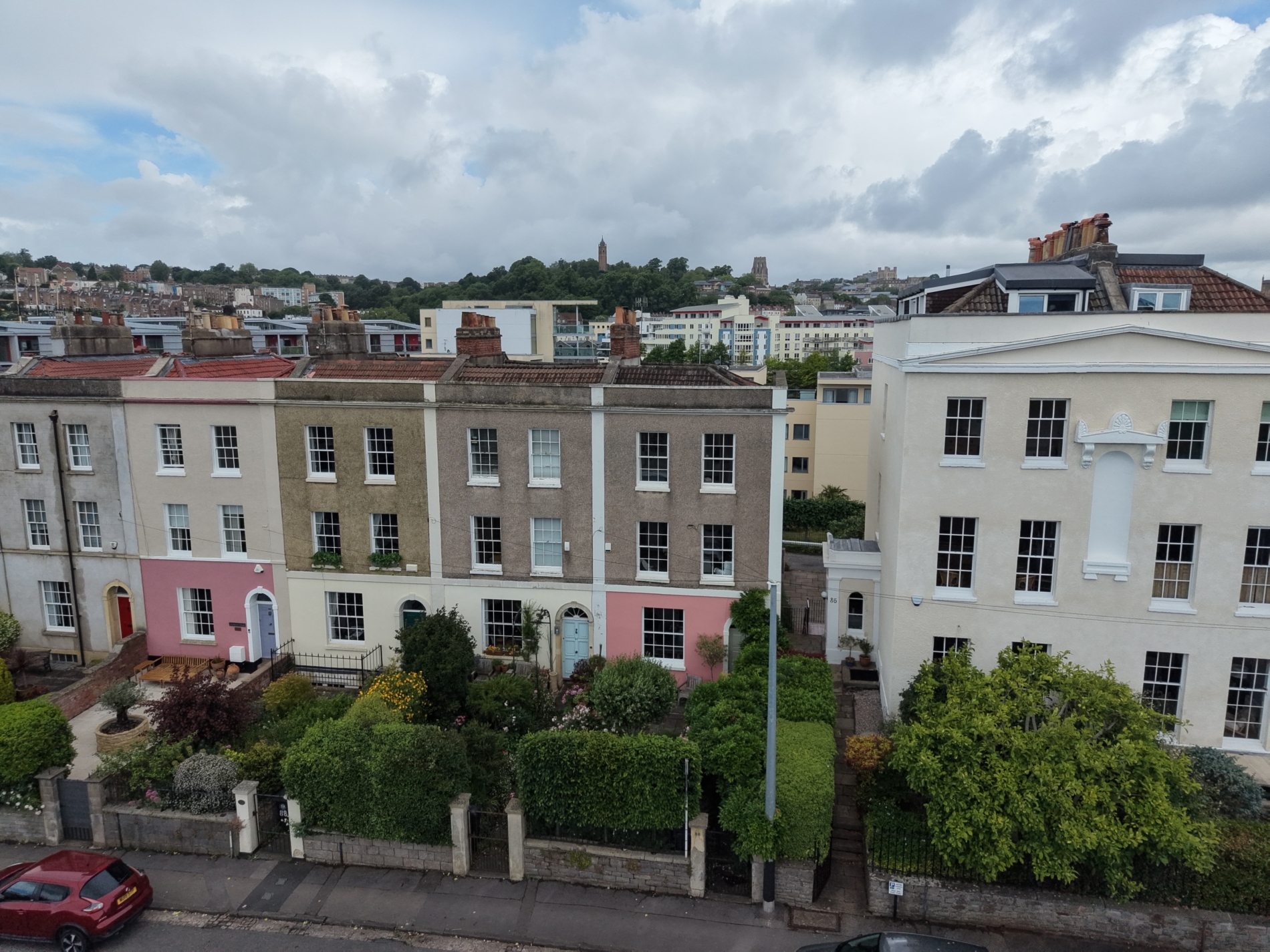
A Georgian townhouse in Clifton, Victorian terrace in Redland, converted property in Cotham or substantially altered house in Bishopston may contain layers of construction and repair that deserve a deeper assessment than a conventional condition report.
Our Level 3 Building Survey considers how the property has been constructed, its current condition and how individual defects may relate to the wider building.
Where suitable, safe and permitted, telescopic pole-camera or drone inspection may be used to improve our view of high-level areas such as roof coverings and chimneys.
Where practicable and agreed, we can also provide indicative repair-cost guidance to assist with budgeting.
RICS Level 3 Building Surveys from £750.

Historic Bristol Requires Historic-Building Knowledge
Listed Building Surveys in Bristol
Bristol contains an extraordinary concentration of listed buildings and conservation areas.
From Georgian terraces and crescents in Clifton to older buildings throughout the city’s historic neighbourhoods, buying a listed property can mean taking responsibility for construction that has evolved over centuries.
Our Listed Building Surveys go beyond a conventional assessment of condition.
Where previous work raises questions about Listed Building Consent, planning permission or Building Regulations, we flag those matters for your solicitor to investigate.
Conservation Does Not Mean Ignoring Defects
Historic buildings move, weather and age.
That does not mean every irregularity is a problem. Equally, something should not be ignored simply because “it’s an old house”.
Our job is to distinguish: character from deterioration, historic movement from potentially active movement, weathering from failure and appropriate repair from unnecessary replacement.
Local vernacular is vast in a small area
Bristol's Traditional Building Materials Matter
A large part of understanding Bristol’s historic buildings is understanding what they are made from.
Across the city you may encounter limestone, Pennant sandstone, Bath or Dundry stone, traditional render, red clay brick, lime-based mortars and combinations of these materials.
In Clifton and Hotwells, for example, local limestone and Pennant stone are among characteristic historic materials.
Materials are not just decorative.
They influence how walls manage moisture, how surfaces weather and how repairs should be approached.
A dense cement repair applied to an older permeable wall may behave very differently from the original construction.
Likewise, replacing weathered stone simply because it looks old may be unnecessary where the material remains serviceable.
Good repair begins with understanding what is already there.
Historic Bristol
Georgian & Regency Property in Clifton and Hotwells
Few parts of Bristol demonstrate the importance of specialist surveying better than Clifton.
Georgian and early nineteenth-century terraces can incorporate:
- solid masonry walls;
- basement accommodation;
- historic roof structures;
- parapets and concealed high-level details;
- sash windows;
- ornate stonework;
- shared party structures;
- and generations of alteration.
Many also occupy sloping sites, meaning lower-ground accommodation, retaining structures and surface-water management can deserve particular attention.
The building may look beautifully presented at viewing.
That does not tell you what lies beneath the decoration.
We consider the building as a whole and explain where its historic construction materially affects maintenance, moisture behaviour or future repair.

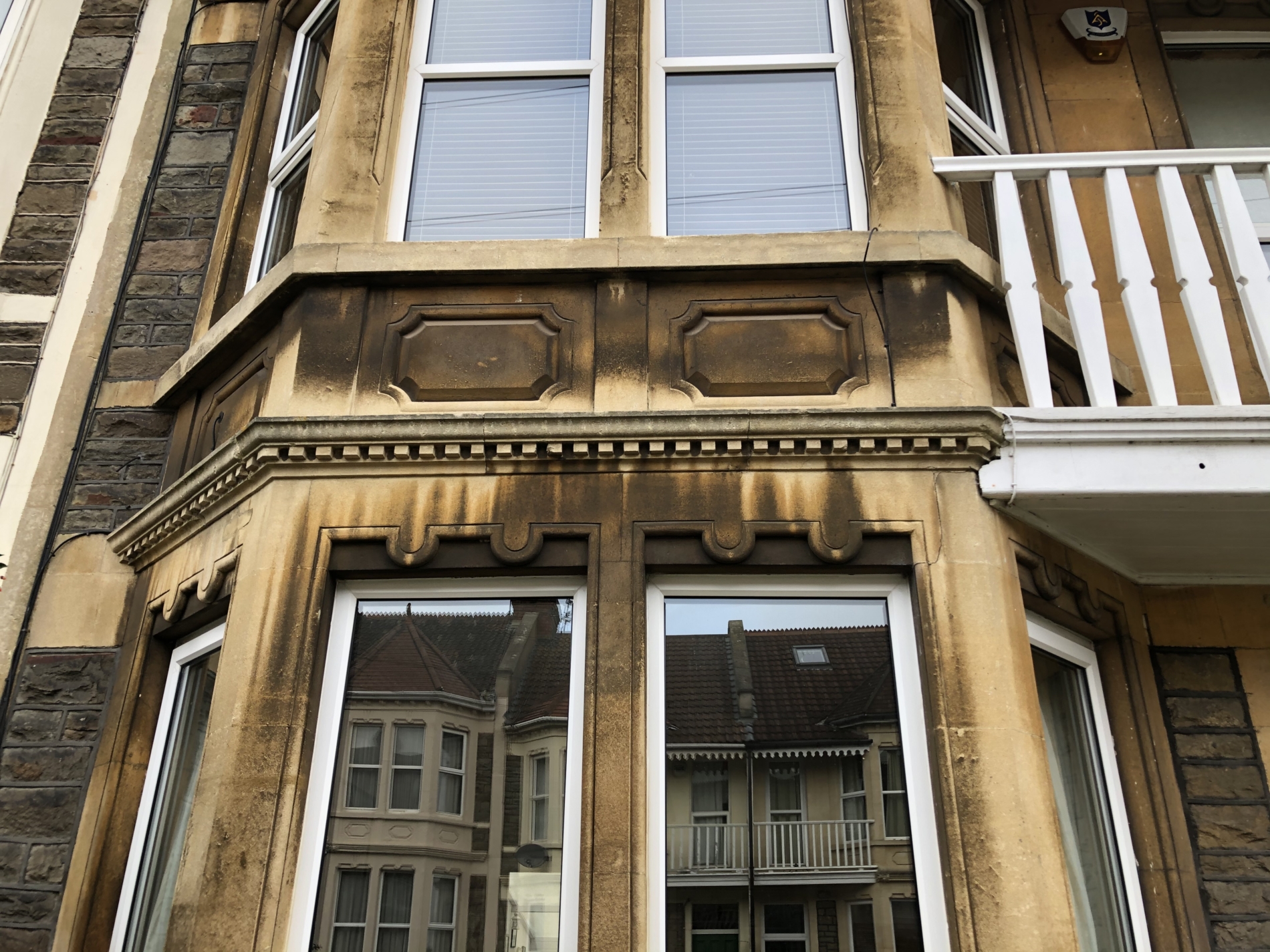
Bristol's Victorian and Edwardian terraces are among the city's most popular homes.
Victorian & Edwardian Houses Across Bristol
They also frequently contain more changes than are immediately obvious.
Properties in areas such as Redland, Bishopston, Cotham, Bedminster and Southville may have been extended, re-roofed, re-rendered, opened up internally, converted into flats or provided with loft accommodation.
Those changes matter.
A survey may need to consider:
- previous removal or alteration of chimney breasts;
- rear and side-return extensions;
- loft conversions;
- altered roof structures;
- replacement windows;
- changes to ventilation;
- dampness at lower levels;
- defective rainwater disposal;
- ageing roof coverings;
- and inappropriate repairs to traditional masonry.
The original house is only part of the story.
The alterations may be equally important.
A Moisture Meter Is a Tool; Not a Diagnosis
Damp and Timber Surveys in Bristol
Dampness is one of the areas where buyers can receive dramatically different advice depending on who investigates the problem.
An elevated meter reading can help identify a pattern.
It does not by itself establish:
- the source of moisture;
- whether a damp-proof course has failed;
- whether chemical treatment is necessary;
- or whether timber replacement is justified.
Our independent damp investigations take a wider building-pathology approach.
We consider factors such as:
- roof and gutter defects;
- rainwater discharge;
- external ground levels;
- leaking services;
- ventilation;
- condensation;
- solid-wall construction;
- previous impermeable renders or pointing;
- basement conditions;
- and timber vulnerability.
Thermal imaging, atmospheric measurements and other diagnostic equipment may be used where appropriate.
The objective is not to find a treatment to sell.
It is to understand the likely cause and recommend a proportionate response.

Where we cover
Building Surveys Throughout Bristol
We carry out surveys across Bristol and surrounding areas, including:
Clifton · Redland · Cotham · Bishopston · Westbury Park · Henleaze · Stoke Bishop · Westbury-on-Trym · Bedminster · Southville · Brislington · Horfield · Montpelier · St Andrews · Totterdown · Hotwells · Harbourside · City Centre and surrounding areas
We also cover North Somerset, South Gloucestershire and the wider West Country.
If you’re unsure whether we cover the property, send us the listing.
Frequently Asked Questions About Building Surveys in Bristol
Our RICS Level 3 Building Surveys start from £750.
The final fee depends on the size, age, construction, condition and complexity of the property and the agreed scope of inspection.
Send us the address or sales listing and we can provide a quotation.
A Level 2 survey is generally appropriate for a conventional property in reasonable condition and of relatively straightforward construction.
A Level 3 survey is more detailed and is normally better suited to older, larger, altered, unusual or visibly defective properties, or where substantial works are planned.
If you’re unsure, send us the property details.
Yes.
Listed and historic buildings are a core part of our work.
We consider traditional construction, historic materials, previous alterations, conservation implications and appropriate repair approaches alongside the building’s overall condition.
Yes.
Our heritage experience is particularly relevant to Georgian and historic properties, including solid masonry construction, basements, traditional materials, roof structures, sash windows and previous alterations.
Yes.
We encourage clients to discuss the findings once they have read the report.
We do not want you to receive a technical document and be left trying to interpret it alone.
With over 200 five star reviews, Smith Heritage Surveyors has earned a strong reputation for delivering clear, professional surveying advice.
Case Study: When £15,000 of Damp-Proofing Wasn’t the Answer
A Victorian Terrace, Damp Concerns and the Value of a Second Opinion
A client approached us while purchasing a Victorian terrace after an earlier building survey had raised concerns about widespread dampness.
A subsequent damp inspection had diagnosed rising damp to the external walls and recommended around £15,000 of remedial work, including chemical damp-proofing and tanking to the internal walls.
Before committing to such extensive and disruptive work, the buyer asked Smith Heritage Surveyors for an independent second opinion.
Looking at the Whole Building
Rather than starting with the assumption that the property required damp-proofing, we investigated the building as a whole.
Our measurements showed that internal relative humidity was above 80%, considerably higher than the external conditions at the time of inspection.
We also found that ventilation within the property was inadequate.
Although extractor fans were present, they were manually operated and the bathroom extractor was discharging directly into the roof space rather than externally.
This was contributing to poor moisture management and condensation within the property.
We also identified other factors requiring attention, including raised external ground levels and areas of cement-based pointing to the traditional masonry.
A Different Diagnosis — and a Different Solution
Our findings did not support immediately carrying out the proposed £15,000 programme of chemical damp-proofing and internal tanking.
Instead, we recommended addressing the causes and contributing factors first.
This included improving ventilation with appropriately controlled extraction, correcting the bathroom ventilation arrangement and dealing with external maintenance issues that could affect moisture movement through the building.
We also provided the client with a longer-term maintenance plan to help improve the property progressively.
Why This Matters for Bristol Buyers
Victorian properties are found throughout Bristol, including Redland, Bishopston, Bedminster, Southville and many surrounding neighbourhoods.
Many were constructed using solid masonry and traditional materials, and they do not always respond well to standardised damp-treatment solutions.
Finding moisture is relatively straightforward.
Understanding why it is there is the important part.
Before committing to extensive damp-proofing, tanking or other invasive treatment, the cause should be properly investigated.
The Lesson
A good survey should not simply identify a symptom and recommend the most extensive repair.
It should ask:
What is causing the problem?
How serious is it?
What is the most proportionate response?
In this case, an independent investigation gave the buyer a much clearer understanding of the property and avoided blindly committing to an invasive £15,000 treatment proposal.
Buying an older property in Bristol? Let’s understand the building before deciding how it should be repaired.
[Get Your Bristol Building Survey Quote]
If you are purchasing, maintaining, or responsible for a historic or period property, Smith Heritage Surveyors can provide clear, professional advice.
Please contact us to discuss your property and arrange an appropriate survey.